Terminated: unknown
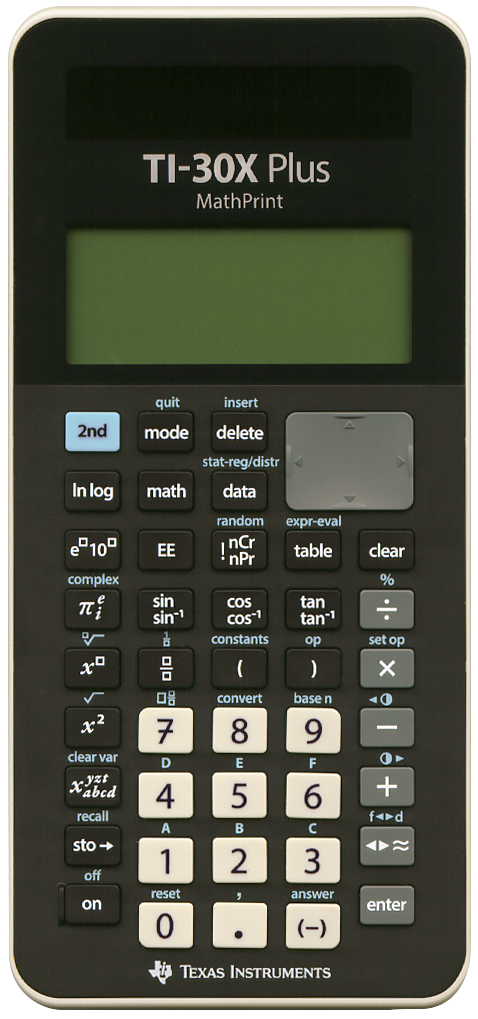
Next to the functionality we are already familiar with from its predecessors such as the TI-30XS it has some interesting extras.
First and foremost this calculator introduces a welcome new method to work with keys that usually need a modifier to select such as the inverse trigonometric functions and exponentials. On this calculator simply press sin twice to select sin−1, press again to select sinh and again to get to sinh−1.
The ln log key, the exponential function key e□10□ and they keys for statistical functions and natural constants and i work in the same manner.
Other extra functionality:
- It has BASE-n capabilities.
- It can do complex number calculations.
- It has a library of unit conversions that can be entered as symbols.
- It has a library of constants that can be entered as symbols.
one drawback however is how difficult it is to replace its two batteries. After removing the screws from the back one has to insert a hopefully non-destructive wedge to lift the front of the calculator off. All the manual has to say about it is:
From the bottom, carefully separate the front from the back. Be careful not to
damage any of the internal parts.
Do not use a knife. Use a plectrum like piece of hard plastic.
So far I’ve found mention of the following types (probably incomplete):
- TI-30
- TI-30 LCD
- TI-30 II
- TI-30 III
- TI-30 SLR
- TI-30 D
- TI-30 SCIENTIFIC
- TI-30 SLR
- TI-30 SLR+
- TI-30 STAT
- TI-30 Challenger (Solar)
- TI-30 GALAXY
- TI-30 GALAXY SLR
- TI-30 SOLAR
- TI-30 S
- TI-30X
- TI-30X Pro
- TI-30Xa
- TI-30Xa/SE
- TI-30X Solar
- TI-30Xa Solar
- TI-30XIIB
- TI-30XIIS
- TI-30XB
- TI-30XS
- TI-30XS Solar
- TI-30XII
- TI-30X Plus (this one)
- TI-30 SR 50