Terminated: unknown
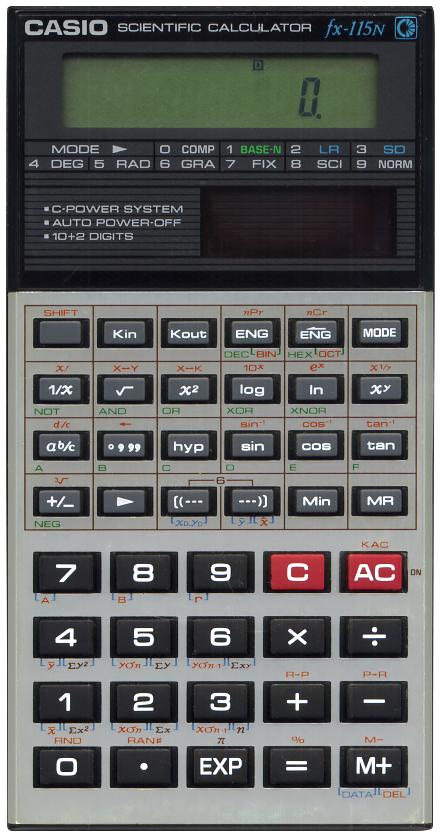
This calculator runs on solar power, even very dim light is enough to power it (as you can see, the lamp of the scanner was enough to start it). It also has a backup lithium battery to safeguard the calculator’s memory.
Reader Toomas Tamm explains why this is:
The battery had indeed been removed when I scanned it.
[...] on the same page it is written that “the lamp of the scanner was enough to start it”. This means that the internal battery has been exhausted. When the battery is fresh, the calculator is powered on by the press of the AC button. Light alone will not start it. When the battery is dead, it starts when light hits the solar cell. Also a curiosity: there is no “off” button. It just times out after several minutes on non-use.
It has ten-digit accuracy and is capable of statistics and the aforementioned BASE-n conversions and calculations.
The calculator has rubber buttons that have an excellent feel. The whole look of the calculator is clean and neat in my opinion.
This calculator (as do many other CASIO scientific calculators) uses one and the same key for both the constant π as well as exponents. This works as follows. When you first enter digits, the EXP key will enable you to enter the exponent, otherwise it will enter the constant π.
There is some interesting information on how one can repair its battery contacts when they are worn out, using graphite paint. Read it on HPMuseum.org here (link validated 2026-01-26).
Many thanks to Richard Pilkington of the University of Salford for donating this calculator to the museum.